Dubai is the largest city in the United Arab Emirates, a Gulf port that grew from a creek-side trading settlement into a glass-and-steel metropolis of malls, beaches, souks and record-setting towers. This Dubai city guide gives you the practical side of a trip: when to go, what things cost, which area suits which traveler, how to move around, what the local rules mean for visitors, and what to check before you book in 2026.
Is Dubai Worth Visiting?
Short answer: yes, if you want a compact mix of city sights, beach time, shopping and a desert trip with very easy logistics, and you can travel between November and April. It is a weaker choice if you want quiet nature, low prices or sightseeing in July and August, when outdoor heat is intense. Read the travel-situation section below before you commit, because 2026 has been an unusual year for Gulf aviation.

Dubai at a Glance
| Country | United Arab Emirates (Dubai is one of seven emirates) |
| Language | Arabic is official; English is used in hotels, malls, taxis and attractions |
| Currency | UAE dirham (AED), pegged at roughly 3.67 per US dollar |
| Time zone | UTC+4, with no daylight saving |
| Population | About 4.58 million at the end of 2025 according to the Dubai Data and Statistics Establishment, and still rising in 2026; most residents are expatriates |
| Working week | Since 2022 the UAE has used a Saturday-Sunday weekend, with Friday a shorter day for many employers; private companies still vary |
| Plugs | Type G (the British three-pin), 230 V |
One correction to a common claim: Dubai is a coastal city, not an island. Its famous island districts, such as the Palm, are man-made additions to the shoreline. You can read more in our guide to the Palm Islands in Dubai.
Check the Travel Situation Before You Book
Since late February 2026, regional conflict has disrupted air travel across the Gulf, including temporary airspace closures that affected the UAE. As of late October 2026, hotels, malls and attractions in Dubai are operating, but government advice remains cautious. The US State Department kept the UAE at Level 3 (Reconsider Travel) in an update dated October 23, and UK guidance updated on October 1 allows travel while warning that no trip can be guaranteed safe. Some foreign airlines have suspended or delayed Dubai routes; reporting in late October said Air France-KLM extended its suspension to October 31 and Cathay Pacific postponed some routes to January 2027.
Separately, news agencies reported on October 24 that Ras Al Khaimah closed its beaches after an offshore oil leak, with precautionary closures in parts of Umm Al Quwain and Sharjah. Check the status of any beach you plan to visit.
This situation can change within days, so treat the paragraph above as a snapshot. Before booking, check your own government’s travel advice, your airline’s current schedule, and the official Dubai Tourism website, and choose flexible or refundable bookings and a travel insurance policy that explicitly covers disruption.
Best Time to Visit Dubai
Roughly November to March is the comfortable season: warm days, cooler evenings and the best conditions for beaches, walking and outdoor dining. April and October are shoulder months that can be pleasant or hot depending on the week. From June to September daytime temperatures commonly pass 40 degrees Celsius with high humidity, which pushes most activity indoors; hotel prices usually drop, but you will spend the day moving between air-conditioned places. Ramadan changes opening hours and daytime dining, and winter holidays bring the highest prices. Our month-by-month breakdown in Dubai weather and climate will help you pick your dates.
How Much Does a Dubai Trip Cost?
Dubai can be done at several price levels, and accommodation is the biggest swing. These are the cost points that are easiest to pin down; confirm current prices before you pay.
- Hotel tax: hotels add a Tourism Dirham fee per room per night, typically in the range of AED 7 to AED 20 depending on the hotel category, plus service charges that are often included in listed rates.
- Public transport: the Nol Silver card costs AED 25 and includes AED 19 of credit. Metro and tram fares are zone-based, roughly AED 3 to AED 7.50 per trip, and a daily cap applies (about AED 14 on the Silver card in mid-2026).
- Food: shawarma counters, bakeries and Indian or Pakistani cafes in Deira, Karama and Satwa are inexpensive. Hotel restaurants, brunches and tower-top dining cost far more.
- Attractions: ticket prices vary by time slot, season and bundle. Booking ahead online is usually cheaper than buying at the door.
A useful rule: pick one or two paid headline experiences per day and fill the rest with free ones, such as waterfront walks, public beaches, the creek abra crossing and window-shopping in the big malls.
Where to Stay: Dubai Areas by Traveler Type
- Downtown Dubai: best for first-timers on a short trip who want Burj Khalifa, the mall and the evening fountain show within walking distance.
- Dubai Marina and JBR: best for beach access, waterfront dining and nightlife on foot. See our guide to Dubai Marina.
- Palm Jumeirah: best for resort stays and families who want a pool-and-beach holiday more than a sightseeing one.
- Jumeirah and Al Sufouh: best for quieter beach hotels and a calmer pace; Jumeirah Beach is the anchor here.
- Deira and Bur Dubai: best for budget travelers and anyone who wants souks, creek views and local food. Distances to the big attractions are larger, so plan Metro time.
For specific properties, including which luxury hotels were closed for renovation in 2026, see our guide to luxury hotels in Dubai.
Getting There and Getting Around
How to get there: most visitors arrive at Dubai International Airport (DXB), which has Metro stations at Terminals 1 and 3, so the Red Line is a cheap way into the city. Al Maktoum International (DWC) handles a smaller share of flights. Abu Dhabi is roughly 90 minutes away by road, and Sharjah is a short drive or bus ride from central Dubai. Details are in our Dubai Airport guide.
Metro and tram: the driverless Metro has a Red Line and a Green Line, and the tram serves Marina and JBR. Cash is not accepted at the gates, so you need a Nol card. Published operating hours in 2026 run from about 5:00 AM to midnight Monday to Thursday and on Saturday, 5:00 AM to 1:00 AM on Friday, and from 8:00 AM on Sunday, but hours shift during holidays, so check the RTA website.
Taxis and ride-hailing: practical for short hops between areas the Metro does not link well, and for evenings. Abras: traditional wooden boats cross Dubai Creek between Deira and Bur Dubai for a very small fare and are worth doing once.
What to Do in Dubai by Available Time
If you have two hours
Stay in Downtown. Walk through The Dubai Mall, then time your visit around the Dubai Fountain evening shows. Show times change, so check the day before. If you want the view from the tower itself, our Burj Khalifa guide explains the ticket options.
If you have half a day
Spend it in old Dubai: wander the Al Fahidi historical district, cross the creek by abra, and browse the spice and gold markets. Our guide to the traditional souks in Dubai covers what to buy and how to bargain politely. Go early or late, because midday sun makes this area tiring from May to October.
If you have a full evening
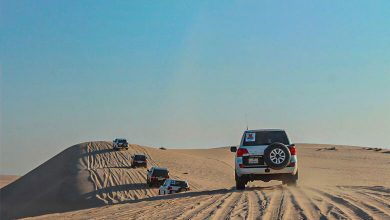
Take the tram or a taxi to the Marina and JBR for a waterfront walk and dinner, or book an evening desert safari that includes dune driving and a camp dinner. If you prefer an attraction, the Dubai Aquarium inside the mall works well in hot weather.
For a full ranked list with booking tips, see our tourist attractions in Dubai. Adventure travelers can also look at skydiving in Dubai, and shoppers should start with the best shopping malls in Dubai.
Where to Eat in Dubai
- Quick and cheap: neighborhood cafes in Deira, Karama and Satwa, and mall food courts.
- Waterfront evenings: restaurant strips around the Marina, JBR and the Creek, where outdoor seating is comfortable in winter.
- Special occasions: hotel restaurants and tower-top venues; book ahead and ask about dress codes.
- Weekend brunch: a well-known Dubai habit, usually a fixed-price buffet at a hotel. Check whether the price includes alcohol or only food.
Most restaurants in malls and hotels are open late, and many places are busiest from Thursday evening through the weekend.
Rules and Etiquette Visitors Should Know
- Alcohol: it is sold in licensed hotel venues, bars and restaurants, and visitors can drink there without a personal licence. Drinking in public places or being intoxicated in public is not allowed, and drink-driving is treated very seriously. Licensed venues may stop serving alcohol on certain religious occasions.
- Drugs and medication: drug laws are strict. Some prescription medicines are controlled in the UAE, so carry the prescription and check the rules before you travel.
- Dress: swimwear is fine at beaches and pools. In malls, souks, mosques and old neighborhoods, cover shoulders and knees. Mosques have their own entry rules.
- Public behavior: avoid public displays of affection beyond hand-holding, keep language polite, and ask before photographing people.
- Drones and photography: flying a drone without a permit is not allowed, and photographing government or security buildings is discouraged.
- Ramadan: eat, drink and smoke discreetly in public during daylight hours; many hotels still serve visitors in designated areas.
Money and Entry Requirements
Cards and contactless payments are accepted almost everywhere, and ATMs are common. Tip around 10 percent in restaurants when no service charge is added. Visa rules depend on your nationality and change, so confirm them with the official UAE government or Dubai immigration channels and your airline, and check that your passport has enough validity left for entry.
Frequently Asked Questions
How do I get to Dubai?
Fly into Dubai International (DXB), then take the Red Line Metro, a taxi or ride-hailing into the city. From Abu Dhabi, a road transfer takes roughly 90 minutes.
What is the best area to stay in Dubai?
Downtown suits first-timers on short trips, Marina and JBR suit beach and nightlife, Palm Jumeirah suits resort holidays, and Deira or Bur Dubai suit budget and culture-focused trips.
How many days do I need in Dubai?
Three full days cover the main sights, a desert trip and some beach time. Add one or two more if you want day trips to other emirates, which our guide to the cities in the UAE can help you plan.
Is Dubai safe for tourists?
Street crime is low and the city is heavily policed and monitored, but 2026 has brought regional security and air-travel disruption. Read the travel-situation section above and follow official advice.
Should I stay in Dubai or Sharjah?
Dubai has more attractions and nightlife; Sharjah is quieter, cheaper and stricter on alcohol. See Dubai or Sharjah for a direct comparison.
Is Dubai expensive?
It can be, mainly because of hotels and branded attractions. Using the Metro, eating in neighborhood restaurants and choosing free beaches and walks keeps costs manageable.
Whatever your budget, Dubai rewards a plan built around one or two anchors per day, an early start in summer and a flexible booking. For events, family-friendly options and market nights, see our guide to Global Village Dubai.