


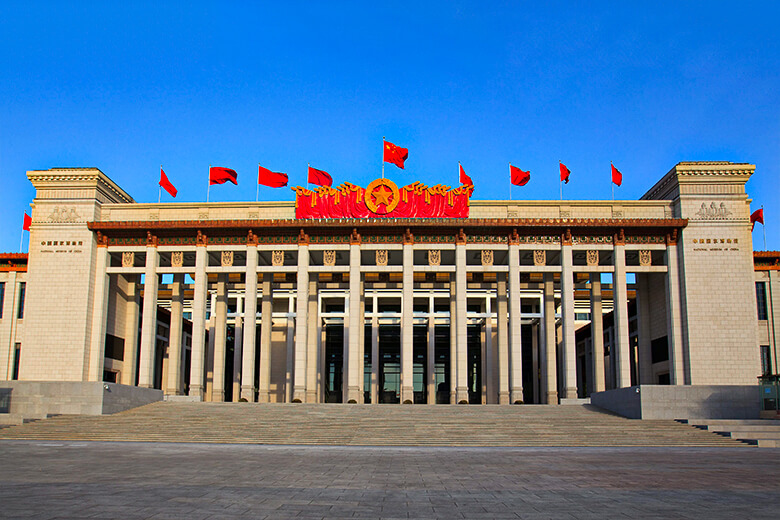
The National Museum in China flanks the eastern side of Tiananmen Square in Beijing, China. The place for viewing artifacts or’s responsible search out experiences about ideas and the past of China. It is supervised by one Ministry of Culture and Tourism of People as the political whole’s Republic of China.
History of the national museum of China
The museum was founded in 2003 by the merger of two distinct museums that shared a building since 1959: the Chinese Revolution Museum in the northern wing (originally the Office of the National Museum of the Revolution, which was established in 1950 to safeguard the revolution’s legacy).
The Public Gallery of Chinese History in the southern wing (beginning in both the Beijing Public History Historical Center, established in 1949 and the Starter Office of the Public Exhibition Hall of the Upheaval established in 1950 to save the tradition of the 1949 transformation).
The skyscraper was constructed in 1959 as one of the Ten Great Buildings commemorating the tenth anniversary of the People’s Republic of China’s inception. It was erected concurrently with the opposite Great Hall of the People. The construction has a frontal length of 313 meters, a height of four floors totaling 40 meters, and a width of 149 meters. The façade has 10 square pillars in the middle.

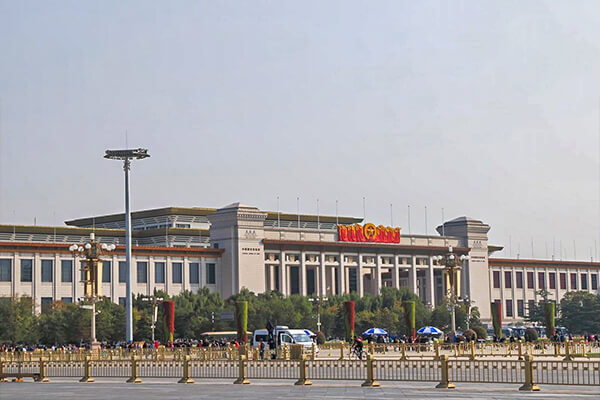
The skyscraper was constructed in 1959 as one of the Ten Great Buildings commemorating the tenth anniversary of the People’s Republic of China’s inception. It was erected concurrently with the opposite Great Hall of the People. The construction has a frontal length of 313 meters, a height of four floors totaling 40 meters, and a width of 149 meters. The façade has 10 square pillars in the middle.
The museum reopened on March 17, 2011, after a four-year makeover, with 28 new exhibition halls, more than tripling the previous display area, and cutting-edge exhibition and storage facilities. It has a total show floor space of over 200,000 m2. Gerkan, Marg, and Partners, a German business, planned the renovations.
The museum reopened on March 17, 2011, after a four-year makeover, with 28 new exhibition halls, more than tripling the previous display area, and cutting-edge exhibition and storage facilities. It has a total show floor space of over 200,000 m2. Gerkan, Marg, and Partners, a German business, planned the renovations.
Collections of the National Museum of China
The museum includes a permanent collection of 1,050,000 pieces, spanning the entire history of China, from the Yuanmou Man of 1.7 million years ago to the end of the Qing Dynasty, with many priceless and rare relics not found in museums anywhere else in China or the rest of the globe.
Among ultimate main articles in the National Museum of China is the “Houmuwu Ding” from the Shang Dynasty, the square-formed Shang Dynasty coppery-brown color zun beautified accompanying four people in agreement heads, an abundant and precious imprinted Western Zhou Dynasty copper water pan, a golden-parqueted Qin Dynasty burnished tally in the shape of a cougar, Han Dynasty jade interment suits stitched accompanying golden fiber, and an inclusive accumulation of Tang Dynasty tri-distorted glassy sancai and Song Dynasty potteries.

The place for viewing artifacts likewise has a main numismatic group, containing 15,000 coins given away by Luo Bozhao.
The museum’s permanent exhibition, The Road to Rejuvenation, shows China’s recent history since the commencement of the First Opium War, with a focus on the historical backdrop of the Chinese Socialist Coalition and its political victories.
The display titled “Field of Hope: A Public Visual Display on ‘Destitution Mitigation and Sharing a Reasonably Prosperous Society” will debut at the museum on April 9, 2021.
The exhibition, organized by the National Museum of China, the China Photographers Association, and the China Federation of Literary and Art Circles, has 180 images by almost 150 different photographers, highlighting the country’s efforts to alleviate poverty.
Countdown clocks at the National Museum of China
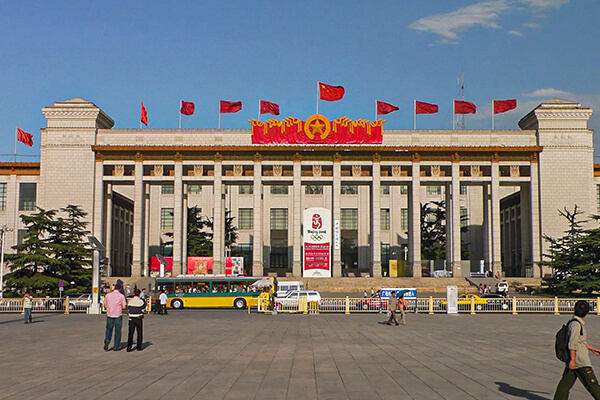
On account of its focal location in Tiananmen Square, the front of the gallery has been utilized since the 1990s to show commencement timekeepers connecting with public occasions like Hong Kong’s 1997 exchange of power, Macau’s 1999 transfer of sovereignty, the beginning of the 2008 Beijing Olympics, and the kickoff of the 2010 World Exhibition in Shanghai.
Controversies on the National Museum of China
A three-month display of the luxury brand Louis Vuitton at the museum in 2011 prompted some criticism of commercialism, with Peking University professor Xia Xueluan arguing that the museum “should only be dedicating itself to non-profit cultural promotion.
” Yves Carcelle, authority and CEO of Louis Vuitton Malletier, justified the display by saying, “What matters is what you will discover.” Before money, I believe there is history: 157 years of innovation and workmanship.”
Some critics have also claimed that the museum’s current historiography focuses on the CCP’s accomplishments while downplaying or disregarding politically sensitive themes like the Great Leap Forward and the Cultural Revolution.
Gallery of the National Museum of China
- A Han Dynasty jade interment suit fastened accompanying golden fiber at the National Museum of China
- A delicate penetrated earthenware container, from the Qianlong Age of the Qing Dynasty
- Copperplate for publication of the Great Ming individual series payment
- Stone etching from the Eastern Han Dynasty, accompanying description of a waterside structure disregarding a basin thorough of find, turtles, and waterfowl
- Bronze two-part pass (prize) accompanying a four-type Tangut message parqueted in bright, from the Western Xia
- A tan container in the shape of a larcenist, from the monument of Lady Fu Hao, from the Shang Dynasty, 13th of one hundred years BC
- Pottery house slab ends from the Western Han Dynasty
- Painted metal relaxation describing a champion from the Later Liang Dynasty
- A Western Han Dynasty jade support from the pit of the Prince of Chu in Shizishan, Xuzhou, Jiangsu responsibility
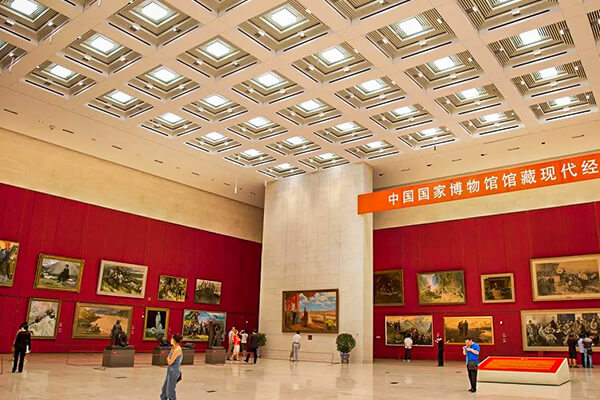
Gallery of the National Museum of China - Red coating box from the Qing Dynasty
- Painted stoneware of neolithic Yangshao sophistication, accompanying rendering of a stork epidemic a net, and a metal cut supplementary
- Bronze tallies accompanying messages parqueted in golden from the Warring States ending, Chu State
- Brick relaxation describing two philosophers and two maids, from the Southern Dynasties
- Bronze plate for publication of an announcement for the Liu classification annoy do business at an establishment Jinan, Song Dynasty. The first surviving model of a monetary announcement
- Bronze ordnance accompanying message out-of-date the 3rd old age of the Zhiyuan Era (1332), Yuan Dynasty
- Large tan bowl of Guo Ji Zi Bai, from Western Zhou
- Li Gui, the first Zhou regime burnished ship expected found, and the only epigraphic evidence of the era of the Zhou defeat of Shang
- Houmuwu Ding, the best piece of burnished work in the direction of the globe before this time. It was fashioned in the late Shang Dynasty at Anyang
- Eagle-formed earthenware of neolithic Yangshao idea
- A Tune Line duplicate of the Representations of Periodical Contribution of Liang, obsolete to the sixth centennial, portraying envoys from random branch states
10 top Hotels near the National Museum of China
- Kerry Hotel, Beijing
- Shangri-La China World Summit Wing, Beijing
- The Peninsula Beijing
- Fairmont Beijing Hotel
- Grand Hyatt Beijing

10 top Hotels near the National Museum of China - Hilton Beijing Wangfujing
- InterContinental Beijing Financial Street
- Lee Garden Service Apartment – Beijing
- Park Hyatt Beijing
- Raffles Beijing Hotel