


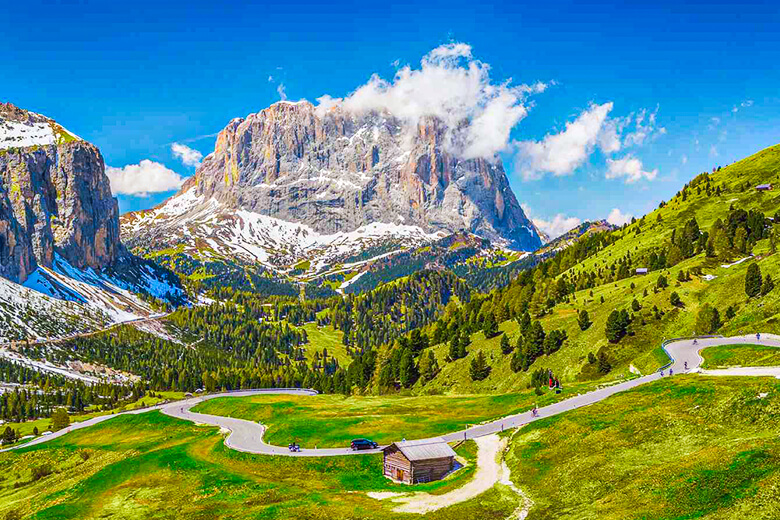
The Dolomites, also known as the Dolomites Mountains, the Dolomites Alps, or the Dolomites Alps, are a mountain range in northeastern Italy. They are part of the Southern Limestone Alps, stretching from the Adige River in the west to the Piave Valley in the east.
The northern and southern borders form the Pusztatal and Suganathar. Located in Trentino Alto Adige, Veneto / Friuli Venezia Giulia, South Tyrol, the Dolomites share an area shared by the provinces of Belluno, Vicenza, Verona, Trentino, Alto Adige, Udine, and Pordenone. We have you covered.
Another group of mountains with a similar geological structure extends east along the Piave River – Dolomiti Dortrepiave. And in the west, far beyond the Adige River, Dolomiti di Brenta. A smaller group, called the Piccole Dolomiti, lies between the provinces of Trentino, Verona, and Vicenza.
Dolomites Bernesi National Park and many other regional parks are located in the Dolomites. In August 2009, the Dolomites were declared a UNESCO World Heritage Site. The UNESCO Global Geopark Adamello Brenta is also located in the Dolomites.
The etymology of the Dolomite Mountain range
Also known as the “Pale Mountains”, the Dolomites’ name comes from the carbonate rock Dolomite. It is named after the 18th-century French mineralogist Deodat Gratte de Dolomieux, who first described the mineral.

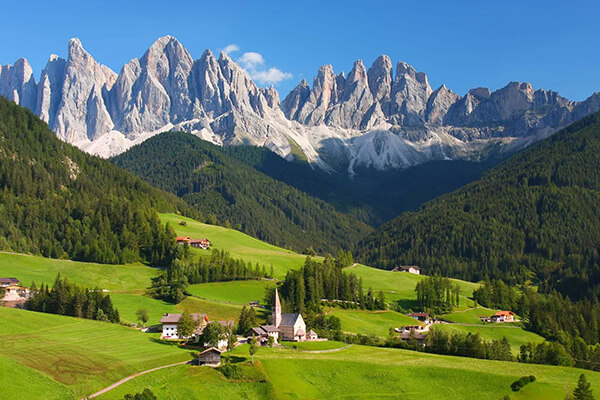
History of the Dolomite Mountain range
For thousands of years, hunter-gatherers have ventured into the highest rocky areas and perhaps even climbed some mountains. It is recorded that the Klagenfurt Jesuit Father Franz von Wulfen climbed Lunkofel and Durenstein in his 1790s. In 1857, John Ball, an Englishman, became the first known person to climb Monte He Pelmo.
Paul Grouman later climbed Anterao, Marmolada, Tofana, Monte Cristallo, Boe, and many other mountains. Around 1860, the Agordan climber Simone de Silvestro was the first person to consciously climb Mount Civetta.
Michael Innerkofler was one of the Three Peaks climbers. He then became a very important local climber and became known for many first ascents, among them were Angelo Dibona and Giovanni his peers.
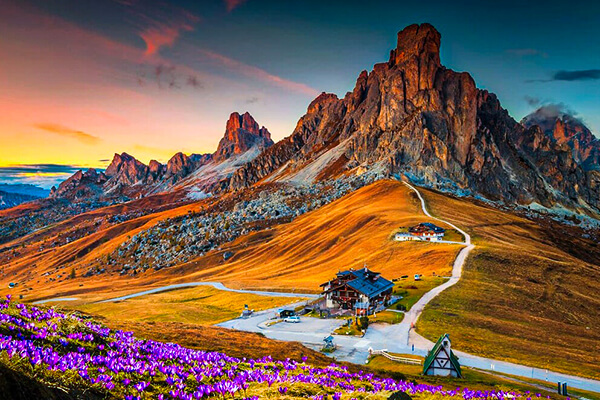
Geography of the Dolomite Mountain range
The region is generally divided into the Western Dolomites and the Eastern Dolomites separated by a line along the axis of the Badia Valley – Campolongo Pass – Cordevole Valley.
Current classification
The Dolomites can be divided into the following mountain ranges:
- Sella
- Marmolada
- Tofane
- Langkofel Group
- Geisler Group
- Peitlerkofel Group
- Puez Group
- Fanes Group
- Schlern Group
- Rosengarten
- Latemar
- Pala
- Lüsen Mountains
- Civetta
- Pelmo
- Marmarole
- Cadini Group
- Cristallo Group
- Sorapiss
- Antelao
- Bosconero
- Vette Feltrine
- Schiara
- Prague Dolomites
- Sexten Dolomites
- Friulian Dolomites
Tourism and Sports of the Dolomite Mountain
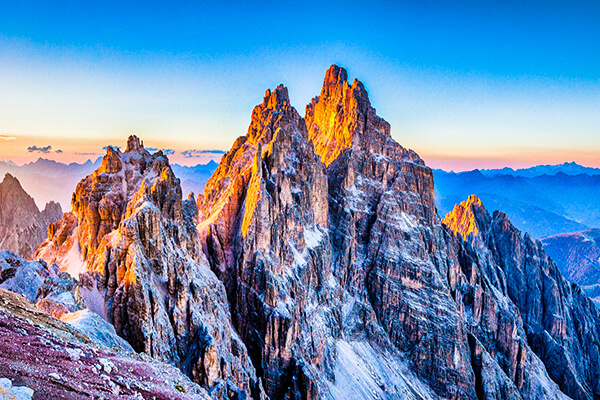
The Dolomites are known for skiing in the winter and mountaineering, hiking, biking, base jumping, paragliding, and hang gliding in the summer and late spring to early autumn. Climbing has been a tradition sport in the Dolomites since 1887 when his 17-year-old Georg Winkler climbed to the top of the Vajolette Tower for the first time.
The main centers include Roccapitorre on the Marmolada glacier on the border of Trentino and Veneto, Alleghe, Falcade, Auronzo, the small towns of Cortina d’Ampezzo, Arabba, Urtigei, San Martino di his Castrozza villages, etc. of Fassa, Val Gardena, and Valbadia. The Marat Nadors Dolomites is his annual one-day road cycling race over his seven mountain passes in the Dolomites, held in the first week of July.
Other distinctive locations are:
- Monte Pasubio and Strada delle 52 Galleries (military mule road with 52 tunnels built during World War I)
- Altopiano di Asiago and Cala del Sasso have the world’s longest public staircase with 4,444 steps.
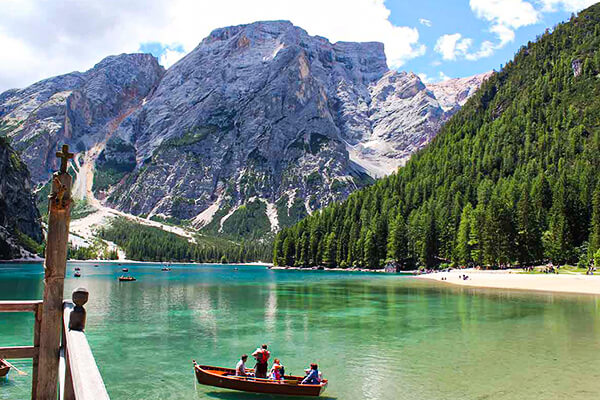
Best Dolomites Hotels
- Hotel de Ren: Central location and luxury rooms in Cortina d’Ampezzo
- Dofthotel Verdey: Creative cuisine, excellent service, cozy atmosphere
- Thermenresort Bad Moos Dolomiten: 2500 m2 wellness area and mineral-rich medicated water
- Naturalhotel Leitlhof: CO2-neutral hotel, excellent cuisine, panoramic wellness area
- Hotel Dolomitenhof: Fantastic location with fishleintal and mountain views
- Hotel Col Alto: Amazing sauna and wellness area
- Utia de Boltz: Unforgettable alpine experience and mountain views
- Hotel Ciasa Soleil: Idyllic views and stylish, intimate atmosphere
- Sportshotel Alpenrose: Unforgettable indoor and outdoor pools, gourmet restaurants, and slope-to-slope access
- Hotel Angelo Engel: Perfect location in Ortisei with or without a car
- Fiori Dolomites Experience Hotel: Great in-house patisserie